Wednesday, January 17, 2007

My List of 30 Inspirations -- 26-30


Now that I'm finished with my list of inspirations, and I'm officially 30 as of today, I am wondering what other writers out there are inspired by. I'd love to hear from you on the big and little things that inspire you to write and create.

26 -- My Girl Heroes

When I was in college, I had a connection with a pretty inspiring group of women. I admired them (and still admire them) so much that I called them my girl heroes. (It was the late 90's, so I called them my grrrl heroes, actually.) We were all aspiring writers and artists at the time and we created our own little artistic community. It has been my pleasure to remain friends with them and see how they all have incorporated their art into their lives. Even though we live all across the country, I can still admire their art from afar. All of us, in our own ways, have remained dedicated to our work.

27 -- Oulipo

I learned about the French Oulipo poetic movement after reading Harryette Mullen's strange and wonderful book Sleeping With the Dictionary. She utilized one of Oulipo's common poetic forms, S+7, where you replace a received text's nouns with the noun 7 positions ahead in the dictionary. The result are poems which are surreal and insightful, at the same time. I personally have experimented with the S+7 form, but I haven't written anything truly remarkable.


Lucille Clifton is one of those poems who is awe-inspiring to me. In some of her best works, like The Terrible Stories, her language is so simple and heart-wrenching. I find her so accessible to read and to teach, which is a joy when you teach poetry to students who hate it. (Or think that they do.) Clifton also is just a remarkable example of a working poet; she has fostered her career for over 30 years, without sacrificing her identity or her other work as a teacher.

29 -- Dreams

Lately, sleep has been on my mind. Part of it is because of my struggles with insomnia over the past year. But part of it is a poet's fascination with the subconscious, with the anachronistic combination of daily minutiae and hidden desires. Other poets have tread these waters, most notably recently, Li Young-Lee and Elizabeth Alexander. I don't know what I can add to this already rich dialogue, but I can't stop including it in my writing.

30 -- Formal Poetry

I know it's 2007 and formal poetry is passe. But formal poetry, for me, provides a level of precision and discipline that free verse does not. When I write in form, I know that there isn't a syllable to spare. I also know that I am (at times) hiding behind the artifice of the form, which intellectualizes my writing. But there are times when a good villanelle can help me access feelings I wouldn't be able to access, without the use of refrain and rhyme. I can't live with it, but I can't quite live without it either.

Tuesday, January 16, 2007

My List of 30 Inspirations -- 21-25


It's officially the last day of my 20's, and I haven't freaked out yet. I keep waiting for the inevitable emotional disaster, and it doesn't arrive. So, perhaps, I really am okay with this 30th birthday thing. One of my good friends, who is many years older than me, says that 30 is nothing to worry about, but 50 can be jarring.


I wish I could say that I love F. Scott Fitzgerald because he is a fellow Minnesota writer. But, I read The Great Gatsby in the tenth grade, when I still lived in L.A. I had been a voracious reader up to this point, but I read whatever was lying around the house. Often the books had little literary merit and I just read to devour. When I read The Great Gatsby, it was my first experience being engrossed in a literary book, not just the trash that I liked to read. When I went to college, I burned through all of his books and loved him. Funny enough, I have never explored all of the Fitzgerald haunts in St. Paul, even though they are only 15 minutes away.

22 -- My Home

When I was applying to graduate school, I was trying to explain in my entrance essay the kind of life I envisioned for myself, with a graduate degree. My boyfriend (now husband) just said, "Be honest -- you want to sit at home all day and write poetry with a kitty in your lap." It was true then and even more true now. While I can't afford to spend all of my time at home, I know it is where I feel the most centered. It's certainly the place where I can be myself, create my art, and feel loved.

23 -- Journals

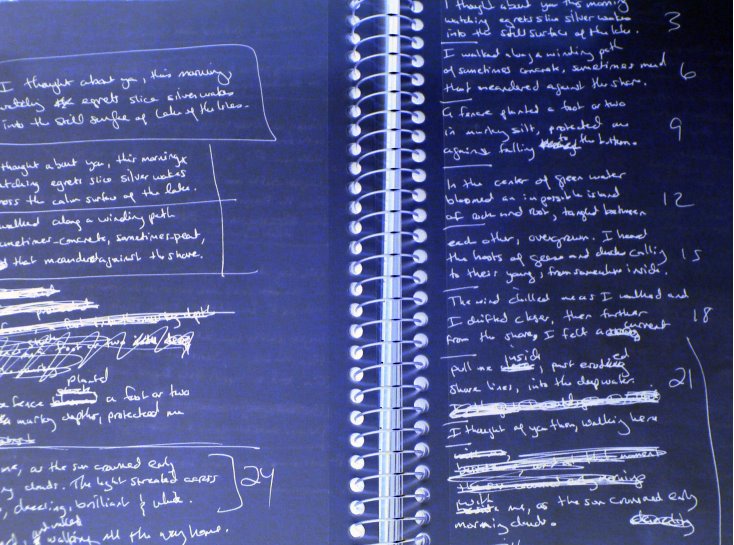
Whenever I start a new creative project, I buy a new journal. Not just any journal but a Academie Sketch Diary in the 9x6 in size. Then, I take my time to decorate the cover in a way that represents the project. In fact, I know that I am ready to start the project, move on from the gestational stage, when I can see the cover of the new journal. Normally, my covers are collage or water colors, and then poor man's laminated with transparent tape. With a good project, I can fill this journal with the rough drafts of the poems. With a bad project, I only fill one or two pages. I'm excited, because I just bought a new journal on Monday. I haven't made the cover yet, but I can see it.


I first read Sylvia Plath in a very stereotypical way. I was a wayward 15 year old who fancied herself a poet and wore black every day. I read The Bell Jar and felt as if she knew what it was like for girls like us. When I went to college, I was incredibly embarrassed by this cliche interest in Plath. But then, I took a senior capstone class on poetics and prosody and we had to analyze a Plath poem, entitled "Point Shirley". I was amazed at the technical dexterity and emotional resonance of this simple poem. After that reading, I devoured whatever I could read by Plath and thought to hell with expectations.

25 -- Tori Amos

I still remember the first time I heard Tori Amos' music. I was sitting in my mom's apartment in L.A. and watching MTV, as I was wont to do for hours on end. And then came on this weird video shot on a white stage with just a woman and a piano. I instantly fell in love with her weird voice, obscure lyrics, and above all, her quiet boldness. As I have followed her career, I have been awed at the beauty and intricacy of her lyrics, even if I don't always know what they are about. As a writer, I am inspired by her ability to create such enduring and unique imagery in her work.

Monday, January 15, 2007

My List of 30 Inspirations -- 16-20


I'd like to point out that this is my 30th post on this blog and I'm celebrating my movement into my 30's with a list of 30 things that inspire me.


I discovered F.L. Block's Weetzie Bat books when I was a freshman in college. I was working in the campus library and making my way through many different authors. I found the original Weetzie Bat book and vaguely remember a good review in a Sassy magazine from years ago. I immediately was entranced by Block's depiction of Los Angeles, my hometown, and the punk-rock girl who lives with her friends and raises an alternative family. In these books, L.A. is as magical and strange as I remembered it and Weetzie Bat presented a realistic and endearing heroine. While I was disappointed with Necklace of Kisses, her adult/chick lit follow up that came out last year, I could read these books a million times.

17 -- Identity

When I started writing poetry, I wrote about who I was at the moment. I was young and trying to cement who I was and who I wasn't. Every word I wrote down was like etching something in wet concrete, changing my surface. I read other writers who were committed to the formation of their identities as women and artists, like Adrienne Rich and Denise Levertov. Now that I'm older, I feel solidified. I feel like I know my heart and my mind, who I am and where I am going, so I don't write about this as much. Without this topic, I wonder where my poems will go, although I seriously doubt that my identity is as set as I assume.

18-- Mixing Media & Genre

I like the lie in writing and art that there are separate and distinct artistic mediums and genres that can never be crossed. It's so false and so easily broken. Right now, I am reading a pretty amazing book by Jodi Picoult called The Tenth Circle. It's a story of a family in crisis and it includes a comic book that mirrors the action, "written" by one of the characters. It's brilliant and seamless. One of my favorite poets, Kevin Young, uses genre in his poetry. His most recent book, Black Maria, is a noir movie in poem form. His first book, Jelly Roll, uses the blues as it's dominant trope. I haven't been able to make that leap yet, in my own writing, but I love to read it in others' work.


When I was 20, I went to Mexico City with my mother. My mother had a conference to go to, and I was allowed free reign of the city during the days. The highlight of my trip was when I went to the Frida Kahlo Museum. The museum was her original home and I was allowed to walk around in it. I saw her gardens and her studios, the bed where she would paint with an easel above her, towards the end of her life. I was (and still am) in awe of her commitment to her art and self-portraiture.

20 -- Living in a city

Right out of college, I lived in the suburbs of Chicago by myself. Of course, I picked the most conservatives of suburbs, because it was adjacent to my new job. After two years of being surrounded by minivans and neocons, I ran back to Minneapolis and the urban neighborhood I lived in during high school. I love it here -- I live in walking distance to downtown and I am surrounded by diversity. I love the rhythm of the neighborhood, the constant hum of activity. This rhythm and hum seeps into my poetry. Most Minnesota poets are really into the beauty and silence of nature, and this has always frustrated me, since we have such a vibrant city. However, a really talented Minneapolis poet, Ed Bok Lee, characterizes the unique flavor of the city in his book Real Karaoke People.

Sunday, January 14, 2007

My List of 30 Inspirations -- 11-15


Now that I'm writing this list. I'm finding inspiration everywhere. I hope I can contain it to only thirty items...guess there's hope for forty yet.

11 -- Language

Andre Breton says, "We are poets because above all we attack language, the worst convention." I don't know if I agree with him anymore. When I was in college, just starting out as a poet, I subscribed to the belief that language is a weapon. I wanted to disarm that weapon. But it's not as easy as that now. I spend most of my time, between teaching and writing, molding language to my purposes (when I can) and marveling at the imprecision of it (when I cannot.) When I wrote my thesis, I labored over every word -- is this the perfect one? Is this? I think, while I understand languages conventions and faults, I am searching for the perfection in language when I write.

12 -- Crap

I don't mean this in a scatological sense, of course. I mean it in the cultural sense. Without crap in our lives, ludicrous, trivial, gaudy, demeaning crap, I would have no topics or themes in my writing. Some if it is media related, but some of it is just all the excess we have in our culture. We are so rich in this country, in resources and people, but we waste so much, because we can. I like to rail against this in my writing, but I also like to submerge myself in it. I think the detritus of our culture tells us more about it, than the things we save.

13 -- Memoirs & Biography

My favorite type of reading, hands down, is memoir and biography. It should be poetry, but I find the chronicles of other people's lives engrossing. Some of the most captivating biographies/memoirs I have read are Zami: A New Spelling of My Name by Audre Lorde, Recollections of My Life as a Woman by Diane DiPrima, Memoirs of a Beatnik also by Diane DiPrima, Desolate Angel by Dennis McNally, and The Lives of the Muses by Francine Prose. As you can see, I am particularly obsessed with how artists and writers chronicle their own lives, or are chronicled by others.
14-- Beat Poets

From the above listings, it's clear that I am a little Beat obsessed. This is odd, because I am entrenched in a life that most Beats would find repressed and bourgeois. But, beneath my 9-to-5 day job and mortgage payments beats a heart of a true Ginsberg, DiPrima, Snyder, Baraka devotee. I love the romance of their lifestyle, of course, but I appreciate their political and artistic aesthetic more. They left us so many gifts in poetry, a critique of our consumerist culture just as it was beginning, a marriage of political ideals and artistic action, and the inclusion of pop culture and daily life in poetry. I couldn't write what I write, without their foundations.


One of my friends from high school gave me Writing Down the Bones for my birthday one year. I've read it dozens of times in the years since. When I began teaching writing at the college level, I immediately turned to Natalie Goldberg's principles for guidance and direction. When we had copyright clearance, I used to force my students to read several of her chapters in Writing Down the Bones. Her approach to writing is so accessible and honest that it resonates with my students, and with me.

Saturday, January 13, 2007

My List of 30 Inspirations -- 6-10


As I've been thinking about this list during the last couple of days, I keep thinking in big terms & social terms. I've been trying to be frivolous and light, but it's not happening. When it comes down to it, the big things are what truly feed me.

6 -- Media
Media is my best friend and my arch nemesis. Without media, I don't know what I would rage against. I also don't know what I'd do with all of my free time. I believe equally in the equalizing power of the media, in the right hands, and the imperialist and conquering force of media in the wrong hands. I am constantly puzzling over the freedom and responsibility of expression.
7 -- Sin & Forgiveness
Sherman Alexie, in his poem Indian Boy Love Song # 1, has this movement of lines about all the people he has lost to their various tragedies, remaining on earth, in sin and forgiveness. That line has been haunting me this afternoon. The idea of Sin and Forgiveness, though, has been haunting me most of my life. As a person, I obsess over my sins, to myself and to others, and I stumble towards forgiveness. As a writer, I like to chronicle perceived sins, and how we work towards forgiveness in ourselves and in our lives.

I think I'm stuck with Elizabeth Bishop. In graduate school, I had to read her Collected Poems in three separate and consecutive classes. Each time was a distinct experience. In some ways, I feel like her clipped, patrician, formal writing represents all the things that are wrong with my writing. I run to her style because it is so bare and precise, but at the same time entirely impenetrable. But then, I read poems like "One Art", "In the Waiting Room", or "Sestina" and I feel lucky when I see that glimpse of honesty and vulnerability. I pray for that kind of awareness and light in my own writing.

9 -- My Past
I don't have much of a real past. Not in a scandalous, lascivious sense. Sometimes, though, it feels like something that I am often trying to escape or to forget. A couple of my best friends have known me since I was 15 (almost half of my life) and they remember me in my dark and embarrassing moments. In my other incarnations. But,even as I run from it and deny, it is such a huge part of me and my writing. I hardly ever write in the present tense. Instead, I chronicle all those moments that I want to forget.

It's seems a little antithetical that a feminist poet would love such a misogynist writer. But I do. This summer, while in California with my dad, I was lucky enough to visit the Henry Miller Library in Big Sur and it was a rush and a thrill. I began reading Miller when I was in college, and I think I am so attracted to his writing because it is so visceral, honest and biting. All qualities I hope to engender in my writing.

Friday, January 12, 2007

My List of 30 Inspirations -- 1-5


Next Wednesday, I'm turning 30. When my husband turned 30 last year, he got a huge back tattoo and panicked about his future. My best friend from college turned 30 two days ago and she drank Irish Car Bombs in a bar. My best friend in Minneapolis turned 30 two years ago and he seriously considered joining the military.

Personally, I'm not having even close to the same response. I thought I would be panicking, but I'm almost serene. I'm planning my celebration and (in my short bursts of free time) contemplating my life. So, in that vein, I'm going to list (in no particular order) the 30 things that inspire me & feed me as a writer.

1 -- SARK
I discovered the writer SARK when I was 15 years old. I had just moved to Minneapolis and I had no one to talk to besides my brother. I was browsing in Orr Books and found her first book, A Creative Companion. Her curlicue writing and colorful doodles inspired me. I began journaling, sporadically, and learned that my creative process was individual and okay.

2 -- My Students
I may gnash my teeth about my job and all the stress, but this past week of teaching has been invigorating. When I get to teach writing to people who are unfamiliar with it, or who outright dislike it, I get to share my passion for my craft. This is truly a gift, especially when they become competent at writing or (shock) start to like it.

Again, this list is in no particular order. If it were in an order, Ani would probably be in the top ten. I saw Ani DiFranco perform at my college when I was 19 years old. I've been hooked ever since. I am amazed at her ability to tell the truth and to make it sound so damn good.

4 -- My Body
I don't think I would be a poet if I didn't honor my sensory experience every day. I know that sounds weird, because of course everyone has sensory experiences every day. But how often do we take the time to notice them? I find that my longest dry spells, as a writer, are when I am spending too much time in my head. I also know that my poems that don't work are ones in which I intellectualize a physical moment.

I didn't discover Muriel Rukeyser for myself until I was in graduate school. I was taking a women's poetry class, one of many in my academic career, and my professor, Patricia Kirkpatrick, introduced me to her criticism and poetry. (If you haven't read The Life of Poetry, you should.) Her poetry is sensual, honesty, political and breathtaking. She is a model for fearless women poets, before there were many.